


Mother’s Day 2026 has been over for about a month now. The adrenaline has worn off, the invoices are settled, and everyone has finally slept. That distance is actually what makes this worth reading — not a hot take from the week after, but a clear-eyed look at what actually happened, now that the dust has settled.
We reached out to florists across the country to collect their honest take on the 2026 season. The responses came from independent shop owners in Hawaii, Michigan, New York, Pennsylvania, Tennessee, Texas, and Florida. Across that geography, a surprisingly clear picture emerged.
This isn’t a deep statistical study. Think of it as a conversation — a candid one — between people who care about this industry. And if you read it with next Mother’s Day in mind, it becomes something even more useful: a planning resource. While every respondent here is a florist, several of the most useful takeaways point just as directly at the growers, wholesalers, and suppliers behind them.
The Short Version: A Solid Season
Not a single respondent rated their 2026 Mother’s Day worse than the year before. Not one. The majority said it was better, and not one florist reported order volumes that fell short of expectations. That’s a meaningful signal, especially in an environment where economic headwinds were supposed to temper consumer spending.
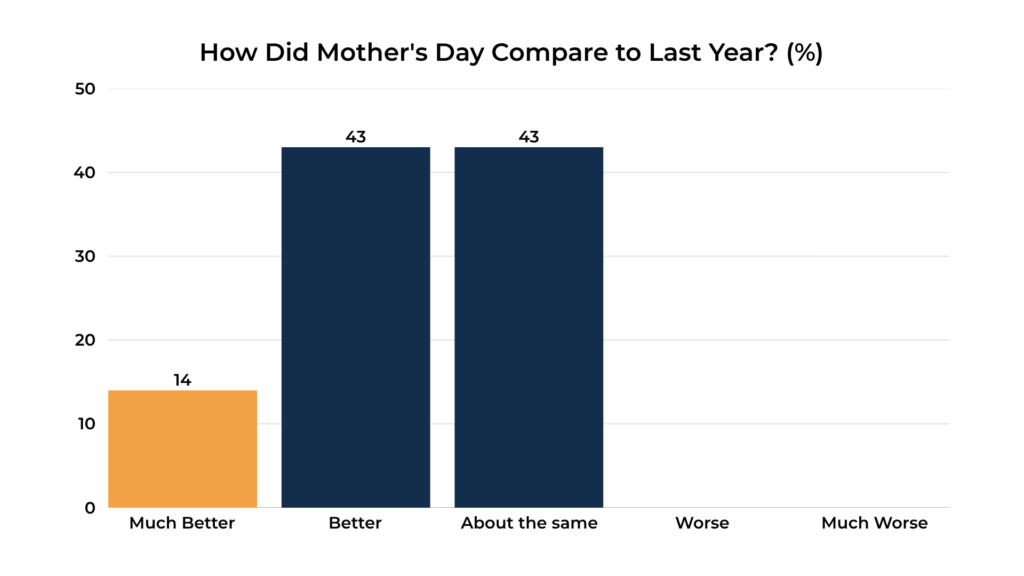
For most shops, the season ran as planned or better. Website and online shop orders were the most commonly cited channel, followed closely by walk-ins and phone calls. Several respondents also flagged “Other” — a reminder that referral channels, regulars, and word-of-mouth still drive meaningful volume that doesn’t fit neatly into any checkbox.
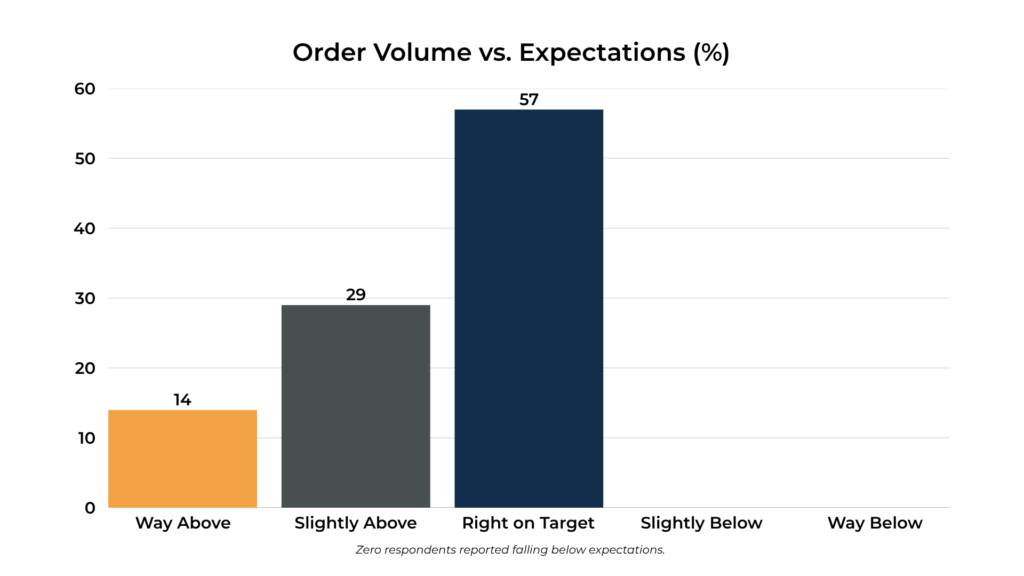
Customers Spent. Sensitivity Was Not the Story.
There was real concern heading into this season that inflation and broader economic anxiety would push customers toward smaller purchases or grocery store bouquets. That concern didn’t materialize in the shops we heard from.
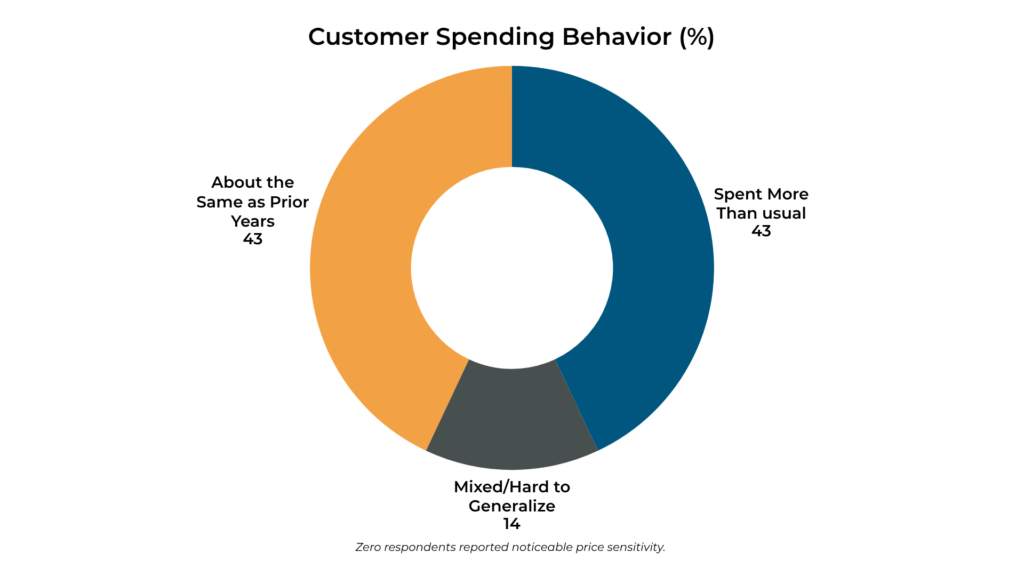
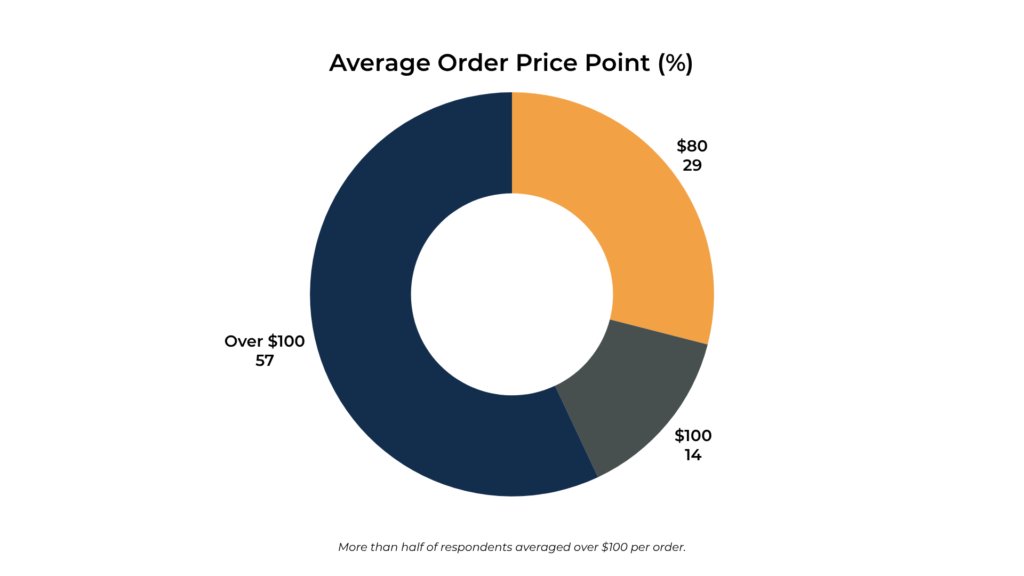
Every respondent reported an average order value of $80 or above, with the majority landing over $100 per arrangement. Customer spending responses were tied between two outcomes — 43% said customers spent more than usual, and an equal 43% said spending held steady with prior years, while the remaining share described it as too mixed to generalize. Nobody reported noticeable price sensitivity.
“Customer expectations on delivery timing and size continue to rise. Grocery stores continue to drive the perception that florists over-price.”
— Nashville Florist
That last point cuts to something real. Even in a strong season, the pressure from mass-market competition doesn’t go away. Customers spent freely this year — but they still walked in having compared prices to what they saw in a supermarket refrigerator case. That’s a positioning challenge that doesn’t resolve itself.
The takeaway for next year: a strong season is not a reason to ease up on communicating your value. If anything, it’s the right moment to deepen that story while customers are engaged and satisfied.
What Sold: Mixed Arrangements Led, Pink Dominated
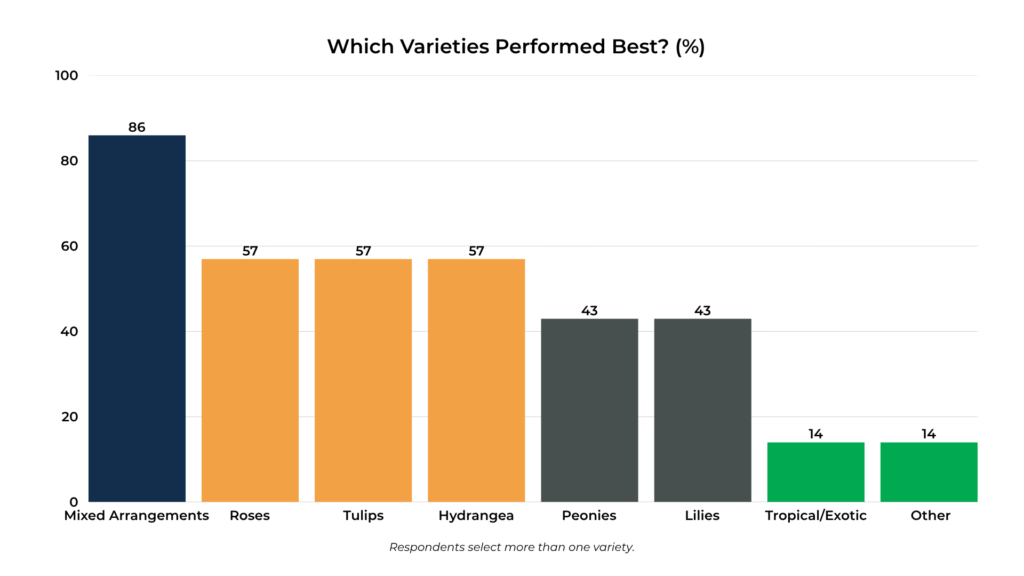
Mixed arrangements and bouquets were the top-performing product category by a wide margin, with roses, tulips, and hydrangea each performing strongly as well. Peonies and lilies were also in demand. Single stems barely registered.
On color, pink was the clear winner — cited across multiple shops in both its softer and more saturated forms. Hot pink, lavender, bi-color, and cream all appeared. Red, which still dominates Valentine’s Day, was much less prominent here.
“My only sourcing problem was peonies. In the past, I have ordered an EB of 60 stems and usually sold them all. I got a phone call 4–5 days before we were supposed to pick up — the farm didn’t ship an EB of 60 stems. After the holiday, we had 40 stems leftover.”
— Miami Beach Florist
That peony story is worth bookmarking. Supply commitments made months out don’t always arrive in the expected form — and the gap between what you ordered and what actually arrives can quietly eat into margin. For 2027, building a small buffer into peony orders (or having a reliable substitution plan ready) is a conversation worth having with your supplier now, not in April.
Supply and Fulfillment: Mostly Solid, With Honest Friction
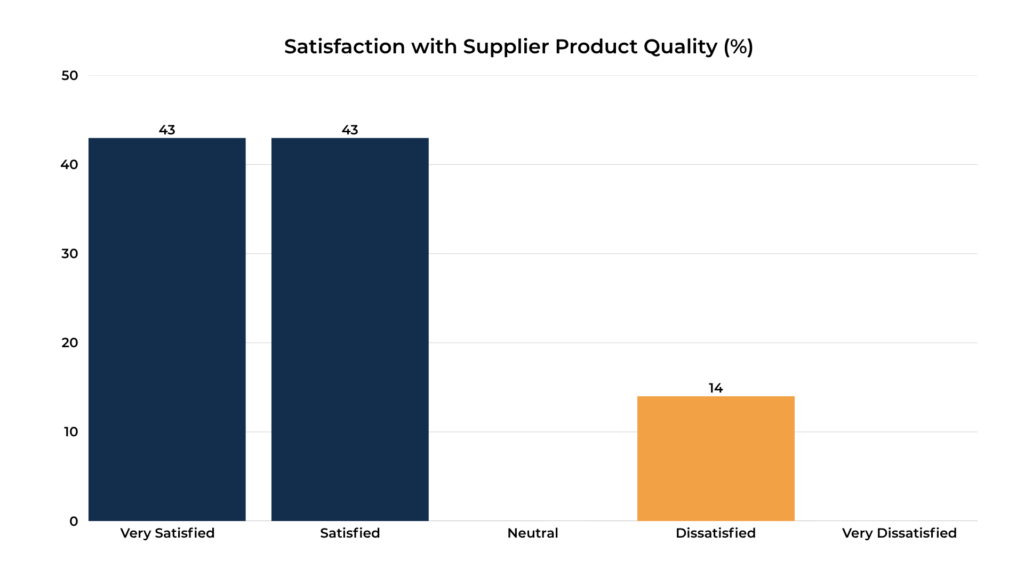
Most respondents fulfilled all orders without issue, while 29% needed minor substitutions. Overall supplier quality ratings leaned positive — 86% said they were very satisfied or satisfied — though 14% flagged meaningful quality issues from a third-party online sourcing platform.
“Flowers from a third-party sourcing platform had a lot of quality issues. Local wholesaler was fine.”
— New York Florist
That distinction — between local wholesaler relationships and online sourcing platforms — is showing up more consistently in industry conversations. Speed and pricing are appealing on paper; vase life and stem consistency are what actually matter when the orders are on the table.
On pricing, responses were mixed. Several florists described supplier pricing as fair and predictable. Others felt it was inflated and put real pressure on margins.
“It is clear that retailers are looking for the wholesaler to take the risks. Many retailers are reluctant to make commitments and are more likely to want to purchase out of the wholesaler’s cooler. Pre-orders up and down the chain are the best way to alleviate this stress.”
— Hawaii Florist/Wholesaler
This comment comes from someone who operates across retail, wholesale, and mass market distribution — which makes it particularly instructive. The reluctance to commit to pre-orders creates pressure at every layer of the supply chain. It’s a systemic issue, and one that better communication and earlier commitment between buyers and sellers could meaningfully address.
The Advance Ordering Gap
One of the clearest patterns in the data: the florists who ordered earliest reported the smoothest seasons. The majority placed orders three to four weeks out or earlier, with several planning two or more months in advance.
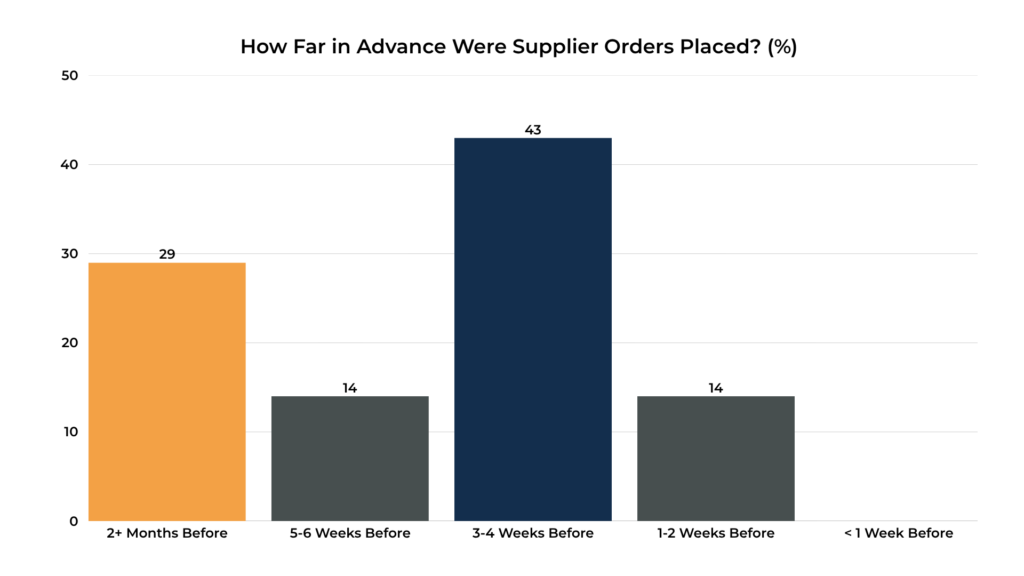
Earlier ordering isn’t just about availability — it’s about pricing stability, substitution room, and reducing the last-minute scramble that costs everyone time and margin.
Staffing: Not the Crisis It Often Is
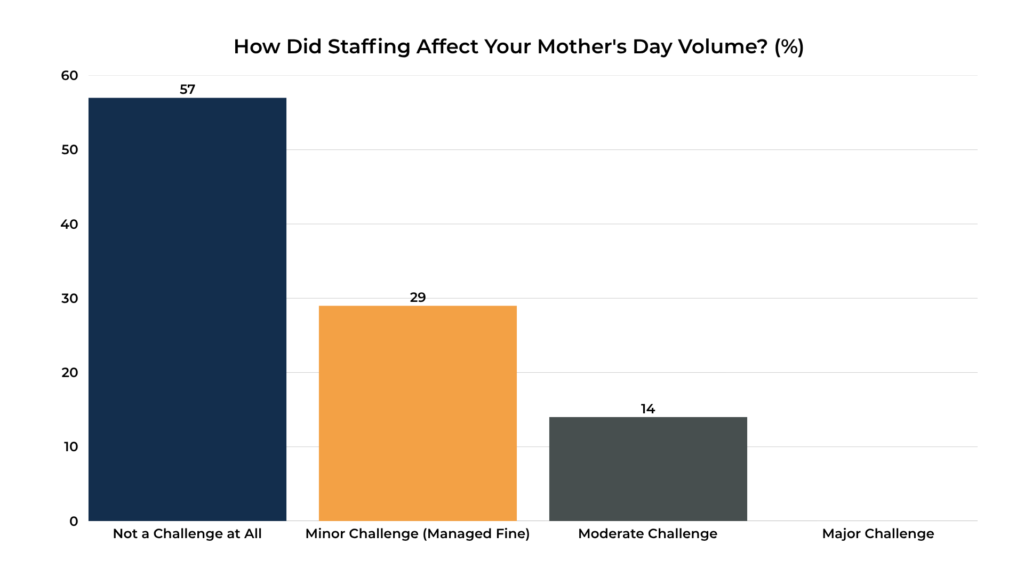
57% of respondents said staffing was not a challenge at all this season, 29% described it as a minor, manageable stress, and 14% noted a moderate impact. The one consistent theme across responses? Getting staff to show up and commit to the long hours.
“Staff not really wanting to work.”
— New York Florist
Long hours are a structural reality of peak floral holidays. The shops that manage it best tend to be the ones that hire seasonal help early, communicate expectations clearly in advance, and build their team culture around a shared identity for this work. Worth addressing now, well before the next peak.
What Florists Want Suppliers to Understand
The open-ended responses to this question were among the most direct in the survey. Three themes surfaced consistently:
- Pre-orders are mutual protection. When florists can’t commit early, it creates a ripple effect on wholesaler planning, variety availability, and pricing.
- Substitutions happen — but communication about them needs to come earlier. A phone call four days out is not enough runway.
- Quality consistency matters more than price, especially on sourcing platforms. Local relationships still earn trust that online portals often don’t.
What This Means for the Year Ahead
Reading across these responses, a few patterns stand out as genuinely useful for planning — not just for next Mother’s Day, but for every peak holiday in between.
Start the supplier conversation earlier. The florists who reported the smoothest seasons were the ones who placed orders two to three months out. If you’re typically a “one-to-two weeks out” buyer, this season’s results are a quiet argument for shifting that habit.
Mixed arrangements are your workhorse. They dominated this season in both volume and satisfaction. If you’re still building your offering around single-variety arrangements as the centerpiece, the florists in this survey suggest a recalibration may be worth exploring.
Pink is not going anywhere. It wasn’t a trend this year — it was a consensus. Softer pinks, hot pinks, lavenders, and blush tones outperformed across geographies. Plan your color palette accordingly.
The value conversation never stops. Spending held up this year. But the pressure from grocery stores and mass-market alternatives didn’t go anywhere either. The florists who feel most secure are the ones who have built a clear, articulate case for what they offer — and communicate it consistently, not just at the point of sale.
A Note on This Survey
This survey was distributed to florists in our network and represents a genuine, unfiltered cross-section of independent shop owners across the United States. Geographic representation spanned the Northeast, South, Southeast, Midwest, and Pacific regions.
The responses here are qualitative and directional — useful for pattern recognition and planning, not statistical extrapolation. We share them in that spirit: as a community resource, not a market report.
We plan to run this survey again ahead of the next major holiday cycle. If you’re a florist and want your voice included, sign up for our newsletter and stay tuned for the next round.