

Season’s greetings! The winter holidays are a critical period for the United States economy and culture. Not only is this a major period of family get-togethers, religion, and celebration, but also the single most important time for shopping. About 20% of annual sales in the United States occur during the six-week holiday period from mid-November to the end of December (National Retail Federation, 2025). This year in particular, the National Federation estimates holiday spending to surpass $1 trillion – the first year ever. This spending coincides with a reported 2% decrease in units (Wyatt, 2025). This indicates overall that per-unit prices are increasing, but it appears that that isn’t dissuading Americans from holiday shopping.
Consumers spend about $850 during the holidays on gifts for others and for themselves, according to a 10-year average (2013-2024) statistic from Capital One Shopping (2025). People are buying online during holidays, specifically via m-commerce. Adobe Business (2025) reports that from November 1st to December 1st, total season spending was $137.4 billion (a +7% Year over Year increase), with $73.7 billion in mobile spending. It is a BIG deal for floral businesses to have smoothly functioning, attractive websites that are compatible with mobile devices.
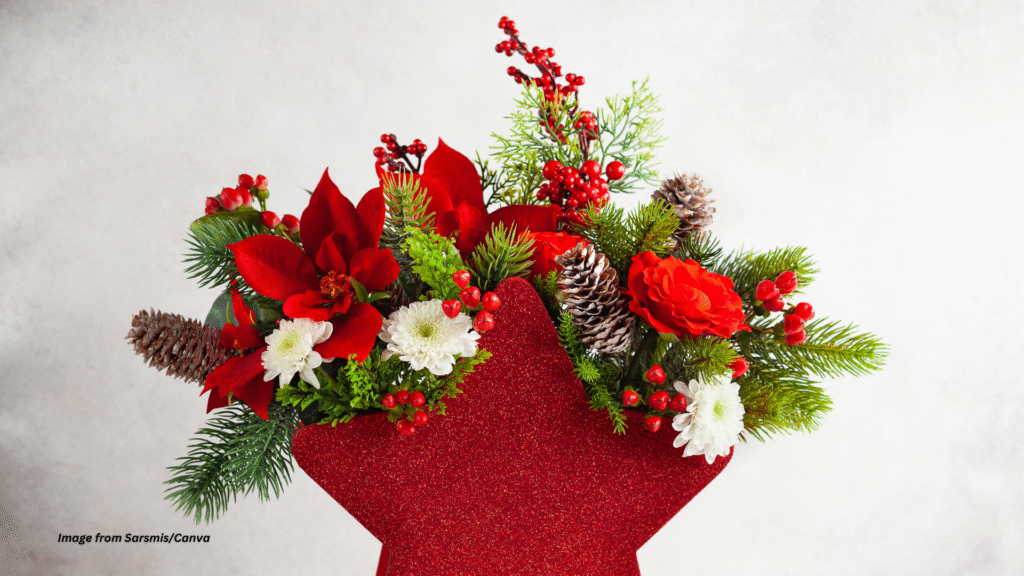
For florals, specifically, we know that Christmas is the third most holiday that Americans buy flowers for – after Valentine’s Day and Mother’s Day. About 20% of floral imports occur during the winter holiday season (U.S. Census, 2025). It’s no secret that our industry is heavily event-based. We have traditionally relied on celebrations and holidays for most of floral purchases, and is still a major part of business. What is interesting is that flowers can be gifts, and they can be part of the home décor, serving two important purposes to the “vibe” (what we used to call atmosphere or mood). So, how to incentivize people to purchase more flowers during the holidays? I have some ideas that I’d like to share:
- Make it memorable. Americans are seeking experiential gifts and purchases. How can you make your bouquet or arrangement part of that experience, OR the main experience?
- Appeal to emotion and tradition. An item that I always think of during the holidays is Christmas cactus. My Minnesotan grandmother’s Christmas cactus would bloom the week of Christmas, usually, and it was always special to walk into her home from the freezing temperatures and see it blooming all cozy in the living room. Whenever I see a Christmas cactus, I think of her and those memories.
- Celebrate culture. Flowers are a major part of most cultural holidays around the globe. Depending on where you are located, you may have the opportunity to provide flowers for cultural events to local consumers that we may not typically think of: Kwanzaa, Yule, Festival of Our Lady of Guadalupe, Hanukkah, and Bodhi Day.
- Maximized decoration. A trend I’ve been seeing online again is people decorating their homes in a maximizing way. For a few years, beige and minimalist decorating have been popular. However, this year it’s been interesting to see the comeback of multi-colored light strings, lots of textures and volume, big mantel swags, tinsels, and garlands. It reminds me of the Home Alone living room.
- Provide for the Do-It-Yourself-ers. If you know you have budget clients, crafters, or do-it-yourself-ers, you may consider marketing a wreath-making kit or swag-making kit that you put-together yourself. Putting together a box of supplies, including the greenery and flowers that the consumer puts together themselves, could create a new opportunity to engage with your customers while minimizing the labor of making the wreaths and swags yourself. Bonus point: kids love making things like this. For some of you who do high-style design with affluent clients, this may not fit into your marketing mix.
I had some fun thinking about these marketing ideas, and I hope you do, too, when interacting with your customers during the holidays.
Here’s to a warm and cheery end of the year and a successful year ahead.
About the Author
Dr. Melinda Knuth is an Assistant Professor at North Carolina State University and a leading researcher at the intersection of people and plants, with a focus on consumer behavior, economics, and supply chains in the floriculture industry. Her work has been widely recognized, including GPN Magazine’s 40 Under 40 award (2021), an AmericanHort Scholarship (2017), and her article What the Research Says About Millennials and Houseplants ranking as one of the top 10 most-read in Greenhouse Product News (2022). Most recently, her poster on AI literacy in horticulture students was voted Outstanding Poster at the 2025 NCSU Conference of Faculty Excellence. Beyond research, she serves as Division Chair of Horticulture for Development with the International Society for Horticulture Science and as a GenNext Lead with AmericanHort.
Published by New Bloom Media
New Bloom Media (NBM) is the first multi-channel B2B media platform dedicated solely to the floral industry across the Americas. Through thought leadership, industry insights, and collaborative storytelling, NBM helps businesses innovate, connect, and thrive.
Want more floral industry insights?
Subscribe to our newsletter for exclusive interviews, market updates, and innovation spotlights delivered straight to your inbox.